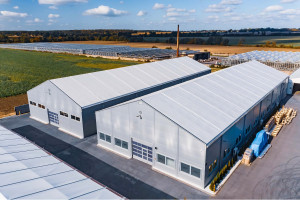
Polish companies are shifting away from long-term, capital-intensive industrial projects. Instead of building facilities for a decade ahead, firms now prioritize speed and staged growth to avoid locking up funds in uncertain times.
In the first three quarters of 2025, gross demand for modern industrial space in Poland exceeded 4.54 million square meters, a 19 percent increase year-on-year. Total market resources surpassed 36 million square meters. The e-commerce sector fuels much of this growth – the Polish online retail market is projected to reach 192 billion zlotys by 2028, growing at an average of 8 percent annually.
Rising costs of materials, energy, and construction add pressure. Longer project timelines increase the risk of budgets becoming obsolete. Companies rarely start expansion at the perfect moment – usually, it happens when warehouses fill up or production bottlenecks appear, leaving little time for careful planning.
Speed and flexibility over long-term planning
– Just a few years ago, firms were ready to plan large investments with a very long lead time. Today, entrepreneurs are much more cautious about freezing capital for many years. Speed of action, the ability to develop in stages, and risk mitigation are what matter – said Piotr Barżykowski, President of the Management Board at Łukasiuk.
Investors increasingly choose phased implementation. First, they build space needed immediately. Then, as production or orders grow, they add new modules. This approach preserves financial liquidity and allows quick responses to market shifts.
Design philosophies are also changing. Companies plan facilities not just for current needs but for specific growth scenarios. A seasonal buffer warehouse looks different from a factory planning a new production line in two years.
Fabric halls as an answer to market demands
Fabric halls, once associated mainly with temporary or seasonal storage, now serve as year-round industrial and logistics facilities. They are used in e-commerce, automotive, agriculture, food processing, recycling, sports and recreation, and even the defense sector. Technology has evolved – these buildings can be designed for high-rack storage or controlled thermal conditions, with insulation, heating, ventilation, lighting, industrial doors, and condensation control systems.
Modularity remains a key advantage. A fabric hall can be expanded without reorganizing the entire plant, relocated to another site, or repurposed. While traditional construction takes months, a fabric hall can be operational within weeks after permits and site preparation.
– Very often, our clients do not want to build everything at once at the target scale. They prefer to expand surface area gradually, alongside business growth. This preserves greater financial liquidity and the ability to react to market changes – added Piotr Barżykowski.
Case study: Polish manufacturer with European reach
Łukasiuk, a Polish-owned company based in Siedlce, has designed and produced fabric halls for industry, logistics, and agriculture for over 12 years. It serves clients across Europe. The numbers speak for themselves: over 1,000 halls built, more than 460,000 square meters of constructed space, and over 850 clients served. In 2025, the firm was recognized by Gazel Biznesu and Diamenty Forbes among the fastest-growing Polish SMEs.
In a competitive market dominated by foreign players, Łukasiuk builds its advantage through quality, customization, and service at every stage – from project to post-sale support. In-house assembly teams ensure consistent standards. Clients receive a 10-year warranty on steel structures and five years on assembly work. Speed and flexibility increasingly determine which company can seize market growth opportunities.
Źródło: wnp.pl, Fot. materiały prasowe / Łukasiuk