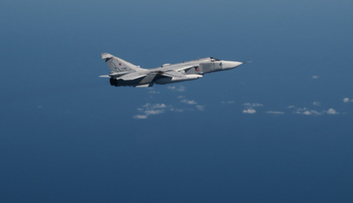
Swedish JAS 39 Gripen fighters intercepted two Russian combat aircraft over the Baltic Sea on Friday, prompting a rapid response from both Stockholm and NATO. The incidents occurred near Swedish airspace, with the military confirming no violations but underscoring a pattern of increasingly assertive Russian activity in the region.
The Swedish Armed Forces reported on Saturday that its rapid reaction force launched two separate operations on Friday to intercept Russian warplanes approaching the country’s southern and northern Baltic zones. The aircraft were identified as a Sukhoi Su-24 Fencer and a Sukhoi Su-34 Fullback, both capable of ground attack and reconnaissance missions.
In an official statement, the Swedish military said that two NATO aircraft were also scrambled to ensure safety in the shared airspace. The coordinated response reflects the growing integration of Sweden’s defense posture with the Alliance, especially since Stockholm became a full member in 2024.
No airspace breach, but serious pattern
Neither of the two Russian sorties violated Swedish territorial airspace, the military stressed. Nonetheless, the frequency of such incidents has raised concern among defense officials. Vice Admiral Ewa Skoog Haslum, head of operations at the Swedish Armed Forces, described the situation in stark terms.
– The Russian actions are serious and repetitive, which threatens both our territorial integrity and our security – said Vice Admiral Ewa Skoog Haslum, head of the operational command of the Swedish Armed Forces.
This is not an isolated event. Over the past year, Swedish and NATO jets have been scrambled multiple times to intercept Russian military planes near the Baltic states, Poland, and now Sweden. The Baltic Sea has become a key theater for such encounters, especially after Finland and Sweden joined NATO, expanding the Alliance’s presence on Russia’s northwestern flank.
Gripen vs. Russian bombers: a familiar dance
The Su-24 Fencer is a Cold War-era tactical bomber, while the Su-34 Fullback is a more modern, heavily armored fighter-bomber designed for low-level strikes. Both types are routinely used by the Russian Aerospace Forces for patrols over the Baltic, often flying with their transponders switched off, which forces NATO and partner air forces to visually identify them.
Sweden’s JAS 39 Gripen, a lightweight multirole fighter, is well suited for rapid interception missions. Since joining NATO, Sweden has also increased its participation in the Alliance’s Baltic Air Policing mission, contributing to a shared early warning and reaction network. The Friday incident highlights the new reality where Swedish airspace is defended not only by national assets but also under the NATO umbrella.
Strategic implications for the Baltic region
The repeated encounters come amid heightened tensions over Russia’s war in Ukraine and its military buildup in the Kaliningrad exclave, which lies between NATO members Poland and Lithuania. Russian long-range aviation activities in the Baltic have been described by Western officials as probe flights designed to test reaction times and demonstrate capability.
Swedish defense planners have long warned that such incidents could escalate if miscalculations occur. The Swedish military continues to monitor Russian naval and air movements closely, and the government has reinforced its defense budget in response. The latest intercepts serve as a reminder that even without crossing borders, hostile posturing carries risks.
Źródło: Polsat News, Fot. Twitter/@SwedishArmedForces