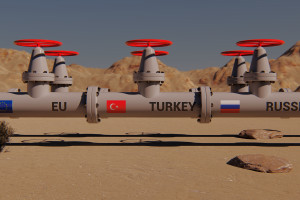
Gas supplies from Russia to Europe via the TurkStream pipeline have been halted due to urgent maintenance work. The suspension, effective until June 10, affects Serbia, Bosnia and Herzegovina, Hungary, and Slovakia.
The maintenance is being carried out at the Russkaya compressor station near the village of Gay-Kodzor in Russia’s Krasnodar region, where the pipeline begins its route across the Black Sea to Turkey. Recent days saw multiple Ukrainian drone attacks on the station, which may have caused partial damage to the infrastructure. Additionally, work is scheduled on the section operated by Bulgaria’s Bulgartransgaz.
The last remaining Russian gas route to Europe
TurkStream is currently the only pipeline through which Gazprom exports gas to Europe after the transit agreement with Ukraine expired. The Nord Stream pipelines were damaged in 2022, and the Yamal-Europe pipeline has been effectively closed. TurkStream consists of two strings, each with a capacity of 15.75 billion cubic meters per year. In 2025, Turkey received 7.6 billion cubic meters for its own use, while European countries imported 18 billion cubic meters via the route. The affected countries – Serbia, Hungary, Slovakia, and Bosnia and Herzegovina – rely heavily on this supply.
Drone attacks and infrastructure vulnerability
The Russkaya compressor station has been a recurring target of Ukrainian drone strikes in recent weeks. According to ENTSOG, the maintenance work is related to both the Russian section and the Bulgarian part of the pipeline. The combination of military attacks and scheduled repairs raises concerns about the long-term reliability of the TurkStream route, which has become a critical energy artery for several Central European nations. The maintenance is expected to last until June 10, but further interruptions cannot be ruled out.
Impact on European energy markets
The shutdown comes at a time when European gas storages are being refilled ahead of the next winter season. A prolonged interruption could force affected countries to draw from their reserves earlier than planned or seek alternative supplies on the spot market, potentially pushing prices higher. Market analysts will be watching closely for any extension of the maintenance period. The situation underscores the ongoing geopolitical tension surrounding Russian energy exports and Europe’s efforts to reduce its dependency on Moscow. The affected governments have urged calm, assuring that there are sufficient reserves to cover a short-term halt. However, if the outage extends beyond June 10, the impact could be more severe.
Źródło: WNP.PL, Fot. Shutterstock