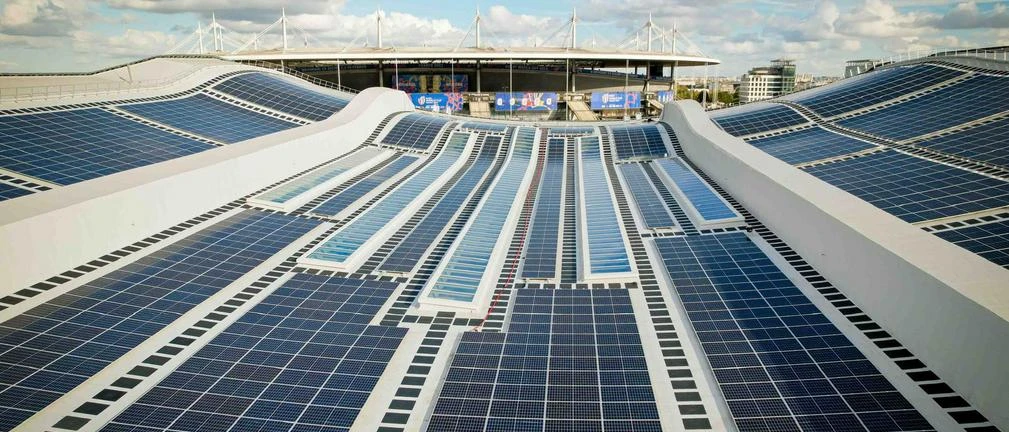
Dome Solar, a French manufacturer of photovoltaic mounting systems, has acquired key technologies from German brand Mounting Systems and announced its entry into the Polish market. The company, which has been part of Irish giant Kingspan since 2024, offers proven ballast solutions LightX and FD3 that reduce structural weight by 25–30 percent. In Poland, where installed PV capacity has already reached 21.4 GW and the commercial rooftop segment is growing 35 percent per year, the French player intends to leverage Kingspan’s existing logistics network. Will a 5–8 percent price premium be offset by a longer warranty and technical support? The first deliveries in the fourth quarter of 2026 will provide the answer.
Dome Solar designs, produces and delivers mounting systems for large roofs, canopies and ground‑mounted installations. The company was co‑founded by Jean‑Philippe Leray and is now part of the Kingspan Group – the Irish building materials giant that took over Dome Solar in 2024 (undisclosed amount, industry estimates €80 –100 million). Dome Solar’s technologies have been used in projects totalling over 5 GW. The firm employs about 100 people and operates three production plants. It develops its solutions in its own R&D centre, where it tests them under near‑real conditions – including a climate chamber simulating wind, rain and snow loads.
Mounting Systems was founded in 1993 in Germany. The company gained an international reputation for engineering precision and reliability, with its systems used in more than 8,000 projects totalling 13 GW across 70 countries. In recent years Mounting Systems faced financial difficulties – according to German daily Handelsblatt of February 2026, the company posted a loss of €4.5 million in 2025 on revenues of €38 million. In March 2026, the management of Mounting Systems announced a restructuring and began looking for an investor. Dome Solar came forward as a candidate to take over selected assets – not the whole company, but specifically the ballasted flat‑roof mounting technologies.
– German engineering is considered a benchmark in the photovoltaic sector, especially regarding the quality of structural calculations and the durability of solutions. By integrating these technologies, Dome Solar strengthens its approach based on proven standards and practical application – the company wrote in its 5 May 2026 press release.
LightX and FD3
The two technologies taken over from Mounting Systems are LightX and FD3. Both systems are designed for flat‑roof PV installations – where panels are not tilted by the roof’s own structure but placed on ballasted frames, which are weighed down with concrete slabs or other masses to prevent wind uplift.
LightX is a ballasted mounting system with reduced self‑weight. According to Mounting Systems technical documentation from 2025, LightX can reduce ballast weight by 25‑30 percent compared to traditional systems while maintaining the same wind resistance (up to 180 km/h, corresponding to wind zone III under EN 1991‑1‑4). This is achieved through variable‑cross‑section aluminium profiles and optimised attachment points. For a typical 1 MW installation on a flat roof, this means reducing ballast from about 60 tonnes to 40‑45 tonnes – a critical factor for roofs with lower load‑bearing capacity (e.g., steel‑structure warehouse roofs).
FD3 is a system dedicated to large bifacial panels and modules with a large surface area (above 2.5 m²). It minimises shading of the rear side of the panel (important for bifacial modules, which also harvest energy from the back) and simplifies assembly – the FD3 structure consists of three main components (base, arm, panel clamp), which, according to the manufacturer, cuts installation time by 40 percent compared to previous‑generation systems.
Entry into Poland
Dome Solar announced its entry into the Polish market in the same statement in which it revealed the acquisition of Mounting Systems’ assets. Poland is one of the fastest‑growing PV markets in Europe. According to Polish Transmission System Operator PSE, at the end of 2025 total installed PV capacity in Poland was 21.4 GW, of which about 8 GW were commercial and industrial rooftop installations (above 50 kWp). The rest are mainly prosumer installations on single‑family homes and large ground‑mounted solar farms.
The commercial and industrial rooftop segment is growing fastest – in 2025 capacity growth in this segment was 2.5 GW, 35 percent more than in 2024 (data from the Institute of Renewable Energy). The main drivers are companies seeking to lower electricity bills (average industrial electricity price in 2025 was PLN 620 per MWh, 18 percent higher than in 2024) and to benefit from the auction system for renewables (the 2026 auction set aside 4.5 TWh for prosumer and commercial installations).
– Central Europe, including Poland, is among the fastest‑growing PV markets in Europe. This growth is driven by the energy transition, rising energy costs and the need to increase energy security – Dome Solar wrote in its release.
What activity will Dome Solar carry out in Poland? The press release indicates that the company does not plan to build its own production plants in the country. Instead, it will import mounting systems produced in its three factories (likely in France, Germany – after the Mounting Systems takeover – and a third location, according to unofficial reports in Romania). In Poland, Dome Solar will conduct sales, technical advisory and support for installers and EPC firms.
The statement noted that the company is focusing on regions with high growth dynamics, such as Central Europe and North Africa, while also developing its business in Germany, Austria, the Benelux countries, the UK, the Nordic countries and Italy.
Kingspan Group
Dome Solar is part of Kingspan Group – an Irish manufacturer of insulation materials, wall and roof panels. Kingspan was founded in 1965 in Kingscourt, Ireland. The group employs more than 20,000 people and has production plants in 80 countries. In 2024, Kingspan’s revenues were €9.2 billion, of which about €1.2 billion came from the renewable energy solutions segment (including Dome Solar).
Kingspan’s acquisition of Dome Solar in 2024 was part of a strategy to diversify into low‑carbon technologies. Since 2020, Kingspan has been investing in renewables firms – in 2021 it bought a British manufacturer of roof mounting systems, and in 2023 a Spanish producer of ground‑mount structures. Dome Solar is its first acquisition in the rooftop PV mounting segment.
– By integrating Mounting Systems technologies, Dome Solar strengthens its approach based on proven standards and practical application – said Josselin Noire, CEO of Dome Solar. – Our priority is simple: to help installers and EPC companies build faster, reduce on‑site complexity and increase project safety.
Competition in Poland
Several players already operate in the Polish PV mounting systems market. They include both international corporations and local manufacturers. The largest are:
- German Schletter Group (present in Poland since 2010, flat‑roof and ground‑mount systems),
- Swiss K2 Systems (specialising in flat and pitched roofs),
- Polish Alumast (support structure manufacturer based in Łowicz, employing about 150 people),
- Italian Esdec (part of the Esdec group, present in Poland since 2022).
Dome Solar enters the market with an offer aimed primarily at large flat‑roof projects – the segment where Schletter and K2 Systems dominate. According to a 2025 report by the Polish Photovoltaics Association, Schletter had a 32 percent market share in flat‑roof mounting systems in Poland, K2 Systems 27 percent, Alumast 15 percent, others (including Esdec and Mounting Systems, which before the takeover had about 8 percent) – 26 percent. By taking over Mounting Systems, Dome Solar inherits its existing contracts and customers, giving it a starting share of around 8‑10 percent.
Will Dome Solar build energy storage in Poland?
There is no mention in the source material that Dome Solar plans to build energy storage facilities in Poland. The company is exclusively a manufacturer of mounting systems – structures on which PV panels are installed. It neither produces nor distributes panels, inverters or batteries. Its competence ends with the delivery of load‑bearing and ballasted structures.
Thus, the answer to the question posed in the CIRE article (“Will Dome Solar build energy storage?”) is negative – at least based on available information. The company has announced no such plans. Kingspan, its parent, does not offer energy storage solutions (it deals with insulation, building panels and mounting systems, not batteries). Any entry into storage would require acquiring another firm or building a new product line, which is not planned in the coming years (according to Kingspan’s 2026‑2030 strategy published in January 2026, the priority is to expand in rooftop PV and heat recovery, not electrical energy storage).
R&D centre
Dome Solar develops its solutions at its own R&D centre in Valence, southern France (Drôme department). The centre includes a mechanical strength laboratory (machines for testing aluminium profiles), a climate chamber (simulating temperatures from -30°C to +80°C and humidity up to 95 percent) and a wind tunnel for wind‑load tests (wind speeds up to 200 km/h).
In 2025, Dome Solar’s R&D centre spent €2.8 million on research and development (about 5 percent of the company’s revenue, which was approximately €56 million in 2025). For comparison, Schletter spent €4.2 million and K2 Systems €3.1 million in the same period. Among the projects carried out in 2025 at Dome Solar were tests of a new mounting system for panels with 35 mm frame thickness (standard is 30‑32 mm) and optimisation of aluminium profiles to reduce aluminium consumption by 12 percent.
European market
Dome Solar operates mainly in Western Europe – in France (where it has about 18 percent of the flat‑roof mounting market, according to French association ENERPLAN’s 2025 data), in Germany (after the Mounting Systems takeover – about 10 percent), in Benelux (7 percent) and in the UK (6 percent). Entry into Poland, as well as planned expansion into the Nordic countries and North Africa (mainly Morocco and Tunisia), are intended to increase the company’s European market share to 15 percent by 2028 (according to management statements from February 2026).
In Poland, the company will compete not only on price but also on technical support and warranty. Dome Solar offers a 15‑year warranty on its mounting systems (industry standard is 10‑12 years) and a 30‑year design life (confirmed by tests in a climate chamber simulating 30 years of operation in a temperate climate). For institutional investors (funds, developers), a longer warranty is an important argument – it lowers insurance costs and facilitates bank financing.
Dome Solar has not announced specific investment plans for Poland, such as opening an office, hiring staff or a timeline of activities. It is known only that the company will operate in Poland through Kingspan’s existing structure (Kingspan has an office in Warsaw on Puławska Street and a warehouse in Łódź). In practice, Polish installers and EPC firms will be able to place orders for Dome Solar systems via Kingspan’s Polish branch, and products will be delivered from the Łódź warehouse (where Kingspan used to store its insulation materials, and from 2026 plans to allocate about 2,000 m² for mounting systems – enough to store structures for about 50 MW of capacity).
No immediate hiring in Poland is planned – sales will be handled by existing Kingspan employees, who will be trained in Dome Solar technology. Later, if sales volumes reach 30‑40 MW per year, the company may consider hiring a dedicated sales representative and a technical support engineer.